About us

Twenty + Six is a couples blog. She is Georgina Marmoy, he is Joshua Smith. We began this blog as a starting point to help us raise money for NACC as the charity helps people who suffer from illnesses which we both have.

We are currently travelling around South America, documenting our stories and snaps for your viewing pleasure!

Sunday, 27 April 2014

The Inca Trail

Inca Trail, Peru 

After the home stay experience, we had around a day to recover before one of the most exciting things planned on our trip. The Inca Trail. With the Inca Trail having to be planned around 6 months in advance in order to get a space, we had basically planned our whole South American trip around this. Getting to our hotel for the night, we met our team and were informed that we had to get everything packed that we wanted to bring down to a weight of just 2.5kg each for the whole trek. So saying goodbye to luxuries (bye shampoo!), having a carb-heavy dinner and early night, before we knew it we were heading to the start of the trail. 

We did our tour with G Adventures. A company we cannot recommend enough if you are planning on doing the same tour. The nice aspect of booking with them is that a part of the money you spend on the tour is put towards community projects in the local area you are visiting. This was made clear to us as we began our tou, with an amazing 5- course gourmet lunch in the newly built G-Adventures restaurant near the Sacred Valley. Built and run by locals, G Adventures backed the project financially and committed to training each employee to exceptionally high standards. It was easily one of the best meals we have had on our whole trip! 

After a couple more stops and an overnight stay in a local town called Ollantaytambo and a good breakfast, we came to the entrance of the Inca Trail. Through passport control and security (they only let 500 people on the trail each day and this is including tour guides and porters), the first day was a fairly straight walk of around 5 hours. The walk began through the valley of the mountains and was a good opportunity to get used to the pace and terrain we had to face for the next few days. The walk ended at lunchtime where we were greeted by our porters and sat down to another amazing lunch. The job the porters do on the Inca Trail is absolutely incredible, they each carry around 25kg through-out the trek, make it to the campsites around 2 hours before us mere walkers and set up our tents, beds, dining tents and cook a 3 course meal all before we make it to the camp! The fact that the porters clapped us every time we made it to a camp was crazy... And did I mention they also made us 3 courses every meal time and a huge cake on a camp stove on our last day?! They did an amazing job, I mean, carrying my small backpack all 4 days felt like hard work! 

The second day was by far the hardest. We walked to the highest point of the trail, 4,215m above sea level, which included around 4 hours of relentless, up-hill climbing and a few hours after walking down. The views were spectacular and definitely made the climb that much easier. The sense of team spirit really became apparent at times like this and we were lucky enough to have a really good group of 6 all spurring each other on and helping to make the gruelling parts that much more bearable. The celebratory rum shot once we made it up to the top was definitely needed. 

We then climbed down and ended the second day camping by a waterfall before the third and longest day on the trail. The third day was a full day of walking in order to get as close to the checkpoint for Machu Picchu as possible ready for the next day. Parts were tough and the terrain was varied, but we were just grateful it was nothing like the climb of the second day. 

The final fourth day was tiring but our favourite day of our trip. The night before we were faced with the option of what time we wanted to wake up in accordance to what position we wanted to be in the queue for the gate into the national park that lead us to Machu Picchu. We were quick to realise that there was fierce competition between the trekking groups who are all keen to be first in line and grab one of only 50 seating spaces available (reminder - 500 people are let on the trail each day). We ended up getting to the gate at 3am and to our utter dismay, discovered we were second in the queue (out of all of the losers, we were the BEST losers) and had to sit and wait until it opened at 5.30am. At that time in the morning, we grateful for somewhere to sit and ultimately were happy with second place. After a couple of hours of sitting up dozing, we began the walk through the park to the sungate. The walk was 45 minutes and it must have been the quickest pace we had through-out the whole trek, with the reality of the end in sight, everyone seemed to want to get there as quick as possible. After climbing the 'monkey steps' - vertical steps which you need to climb on your hands and knees and watching someone snap their walking stick in half stopping themselves from almost falling over the edge, we made it to the sungate. The first glimpse of Machu Picchu below at the bottom of the mountain. We had made it. The sun was rising and we didn't stop for too long as each group wanted to make it to Machu Picchu before it got too busy. The walk down the mountain was exciting, with adrenaline kicking in that after 4 days of walking we had made it and that the end was in sight.

Machu Picchu in reality is even better than the pictures. The site itself is huge and worth trekking for 4 days straight. It's an incredible sight with lots of history that luckily our tour guide informed us all about. Before doing the trail, I was skeptical about how underwhelming the sight could be after having to trek for that long and expecting so much, but I'm happy to say I was absolutely blown away and was one of the best things I have ever done. If you are even thinking about doing it, do it (like right now). If you're not, you should. 


Friday, 25 April 2014

Amantani homestay

Lake Titikaka, Peru

We've got a little behind on these little blog updates but after almost 4 weeks here, here's our first post in Peru (no sightings of Paddington Bear just yet).

Our first taste of Peruvian life led us to the highest lake in the world, Lake Titikaka to visit the island of Amantani and stay with a local family.

Our journey started nice and early as we were picked up from our hostel in Puno and transported down to the lake. After buying some presents (rice, apples and a colouring book) for our host family, we were led on to our boat and serenaded by the soothing tones of the Beatles, as played on panpipes.
We were then introduced to our tour guide, who referred to himself only as 'Bruno from Puno'. As you can imagine he was quite the character.

A short boat trip led us to the floating islands. These are a set of islands made out of reeds, created to evade the attacks of the Incas and still house large communities even to this day.
We were shown how the islands are made from blocks of reed roots which are fastened together and covered in reeds before being anchored down. If these folk fall out with the neighbours, the good news is they can just upsticks and float a little further downstream.

The reeds really are a huge resource for these people, not only do they live on them, they eat them too (if you take the very base of one and unravel it it can also be a particularly effective hangover cure if then placed on your forehead!). After tasting some reeds- which i guess tastes like celery(?!), we were given a ride on a local water taxi to the nearest floating island to see how the locals get about, before heading off to Amantani.

Once there we met our host for the night, a single Mum called Sofia. She had a crazy four year old son who we first thought was called Pedro, but later discovered to be called Juan Sebastian. Yep, our Spanish still needs some work. After letting him pelt a football at me for an hour (this kid didnt understand a game of passing) we regrouped with everyone from our boat and hiked up to the island's highest point to watch  the sunset. This gave us our first bit of training for Machu Piccu as the hike was pretty steep and tough going, but luckily only short in duration and the beauty of the sunset made it totally worth the effort.

Once we had descended we headed back for some dinner before going out for the evening's main event, a dance at the local village hall. Decked out in local attire, a poncho and hat for me and a very tight fitting dress and scarf for Georgie, we headed out. A short, but tricky to navigate in the dark, walk later we made it to the hall.. and we were the first ones there! We sat there quietly hoping others would show up as 3 Peruvians working the bar and the band sat and stared back at us in silence. This was awkward to the extreme.

It seemed like hours passed (in reality it was more like 10-15 minutes) before, luckily for us, other fellow tourists started making their way through the doors and the party started.
Although we were all completely unaccustomed to the music, our hosts soon showed is the appropriate dance moves (no robot or moonwalk necessary here) and Sofia was always the first off her seat which meant I was always the lucky first tourist having a go at each dance! We were also lucky enough to bump in to some of the friends we made on our Slat Flats trip so together with them, we merrily danced the night away!

The next morning was started with pancakes for breakfast (my favourite!) before saying our goodbyes to our host family. Pedro kept things formal, offering us a handshake each.
After a short boat ride we then hiked another island and got to know some of the other tourists a bit better, where we made plans to meet for dinner that evening.

Another boat ride led us back to Puno where we had the best steak, called lomo, we've ever had in our lives and after a few beers our wonderful trip was over.


Tuesday, 8 April 2014

Sucre & Round Two of La Paz

Sucre & La Paz, Bolivia

From the mines we were happy to move on to Bolivia's former capital city, Sucre. We found that it didn't have too much to offer, but was a welcome rest. We visited the cathedral and adjoining museum, which left us a little freaked out with lots of statues of religious figures that seemed to stare at us anywhere that we went. 

Sucre gave us a chance to catch up on sleep, before heading back to La Paz to begin our journey out of Bolivia and onto Peru. The only thing in La Paz we had left to do was 'The worlds most dangerous road' but hearing of someone we met breaking their collarbone cycling the road just as we arrived to La Paz, we opted to visit Tiwanaku, a pre-Inka site, instead.

Heading straight off an all-night bus and onto another one to visit Tiwanaku, we tried to stay awake to take in all the information our tour guide gave us. Tiwanku was a pre-Inka site that is still being discovered and was a small town that inhabited lots of farmers. Over 60% of the information has been lost about the site, but the visit got is excited about our visit to Macchu Pichu! The Inkas had beliefs similar to the Egyptains regarding the after-life and we saw the process of mummification and beheading. 

After the tour and hearing about 'the highest Indian restaurant in the world', we decided to head to The Star of India for dinner. Ordering a Tandoori and Korma, I'm afraid to say we were disappointed and were not impressed with the quality of the food, especially with the craving of a homemade curry back home! This led to an early night before heading to Puno, Peru in the morning and heading to Lake Titikaka for a home stay with a family on the Armintani Island. 


Wednesday, 26 March 2014

The Mines of Potosi

Potosi, Bolivia

Potosi, the self proclaimed "highest city in the world", was just a short bus journey on from Uyuni. After our trip to see the Salt Flats we thought we had started to acclimatise and felt much more confident of dealing with being so high up. But the altitude came and slapped us in the face again.
Unable to do much more than grab a quick dinner of fried chicken (which is hugely popular here in Bolivia, by the way) we made straight for our hostel to rest up.
The hostel we chose, Juan Carlos V, was another fine choice. We had some difficulty aquiring a room to begin with, as we only speak "un poco de español" and our new landlord spoke even less English, but after a lot of gesturing and some fine translation from one of the other guests we were all booked in for the night.
After dumping our bags in our room we made for the rooftop terrace which gave a beautiful view of the city and many mountains surrounding it. It's astonishing to think that so many people could find their way to and live so happily tucked away in those mountains.
The next day there was only one thing on my mind - go to see the mines. Potosi is famous for it's mines, which produce silver and zinc among other natural resources and caused something of a silver rush amoung Europeans in the 1500s. Georgie, though, was understandably nervous about heading in. We decided to book with a company called Real Deal Tours after being recommended them by a friend we met on our Salt Flats expedition. She had also been nervous about being in the confined space but had assured us that she hadn't felt too scared on this tour.
So we handed our money over and waited to depart.
First up we went to a local market as it is the custom to buy presents for any miners you encounter whilst trawling through the mines. Common items to pick from include drinks (mining is thirsty work), Coca Leaves (miners love to chew on these as they work away) and dynamite (apparently quite useful in the mining industry). We went with drinks and coca leaves.
We then got kitted out in waterproof over layers, breathing masks and miners helmets and made our way to the mines.
They were so interesting, both in how vast they have become (the sheer manpower it will have taken to carve these labyrinths in to the mountains is crazy!) and in seeing how these people earn their livings. Our tour guide Efrain told us that his father had worked down the mines for 70 years and out of those that we bumped in to this number ranged from 12 to 40 odd. To try and add a little perspective to that, we came out with heavy lungs from all the dust and debris from spending barely 2 hours inside and we had worn masks.
Now these mines aren't exactly Moria but they are pretty scary in parts. The worst of which came when we had to scale three flights of ladders in quick succession, I didn't dare look down. Oh and once we'd done this we came face to face with the devil, or 'Teo' as the locals call him. It is their belief that he owns all of the minerals in the mountains and as such they have built a statue of and regularly pay homage to him, offering llama blood, coca leaves and alcohol as marks of respect.The interesting part about the alcohol is that it is 96%, this is because the miners believe that by drinking the purest alcohol possible, Teo will reward them with pure Silver and not a mixture of elements that then need refining.
You can also add to this frightfulness the nightmare of nightmares - I dropped the first memory card we used in our camera somewhere in the mine. I'm so annoyed that we've lost 150 odd images from our first few days in Rio, but hey, at least we didn't run in to a Balrog!
 

Tuesday, 25 March 2014

Beginning Bolivia


La Paz & Salar de Uyuni, Bolivia

After 3 flights, a 6 hour layover, 2 slices of pizza and 2 milkshakes we made it to our second country- Bolivia. The first thing that hit us landing in La Paz was the altitude. Not being able to take more than a few steps without needing to take a breather was a challenge, especially after a long day of flights and with big backpacks.

Luckily we checked in to a lovely hostel in La Paz 'Arthy's Guesthouse' which had rooms built around a central courtyard and a kitchen for us to make a quick dinner before heading to bed. 

We are travelling Bolivia by bus so most places we only see for one or two days. Our first stop. La Paz. Still feeling the altitude on our first day in Bolivia, we visited the markets - something we were told La Paz is famous for. These are dotted all over the city, with various items for sale - vegetables (avacados the size of my head), lightbulbs, football shirts and so much more. With a maze of different things for sale, we also wanted to have a look at the 'Witches Market', which was supposed to offer up some unusual items.

Meandering through various side streets, we found the Witches Market and before we knew it came face to face with dead dried llamas. This came as a little shock at first, but we later found out that they are llama fetuses, that are buried outside houses as a form of protection from evil sprits. Various other unusual items were also found as we walked cautiously through the market such as dried bird beaks and crushed bugs, all said to be used as natural remedies and cures. We decided to just stuck to paracedomal for the time being.

After a short stop in La Paz, we headed on to an overnight bus to Uyuni, this was where we went on a tour to do our main activity in Bolivia - the Salt Flats (or Salar de Uyuni to the native tongue)! Uyuni is a very small and dusty town with not much going but we managed to eat well, rest up and get ready for our tour. 

We went on a 3 day jeep tour with Red Planet Tours, who we would highly recommend. The first day we drove across the salt flats which was an incredible experience. The Salt Flats themselves are almost as big as Northern Ireland and it looked like smooth snow for miles. After the obligatory perspective photo shoot on the salt flats we visited Fish Island, where an island of cacti had grown over hundreds of years in the middle of the salt flats. This was enough for the first day as we stayed in a basic hostel in the middle of nowhere. We had a chance to get to know the people in our jeep (particularly our Bolivian tour guide Juan who told us all about life as a llama farmer) and enjoy some delicious Bolivian dinner before bed.

The next day begun by a trip to the lake to see the Flamingos who lived in the middle of the salt flats and we also saw the Red Lake where the water had been coloured by the materials from the nearby mountains. We were then taken to the Sol de Mañana Geyser - where we saw hot bubbling mud coming out from the ground at over 200C. The day ended perfectly with dinner and the chance to bathe in the natural thermal springs on top of the mountains and look out at the stars for hours. We were told this is one of the best places in the world for star gazing, being so high up there is very little light pollution and the air is so thin.

The final day we stopped off at the Salvador Dahli desert- somewhere that supposedly inspired Dahli's works and the rock tree that had formed through wind to look like a tree before heading back to Uyuni town amazed by the different sights.


Tuesday, 18 March 2014

Rio Roundup

Rio de Janeiro, Brazil

We've found it helpful reading other blogs for advice whilst in Rio, it's helped us to holiday on a budget, pick out the best places to go as well as pick up little tips and tricks along the way so we thought we'd do our own roundup for anyone thinking of coming to Rio de Janiero (you should.. It's amazing!)

Transport
Getting around Rio is super easy - at first we were scared to dive in to public transport and preferred to get taxis around. How foolish we were. For R$3 you can hop on a bus to anywhere in the city and the metro is only slightly more expensive. All routes can be found on the bus stops around the town. The metro costs R$3.25 for a one way journey, but is good for journeys when you're venturing further out.

Accommodation
The only accommodation we used was Airbnb and we found this to be brilliant. Our host Jaqueline was great - providing us with that extra bit of local knowledge that can be so useful on many occasions. Where we stayed in Copacabana we spotted a few hostels, but if you plan to go at carnival times, booking hostels way in advance or Airbnb is your best and cheapest bet.

Days out 
One thing is sure about visiting Rio - you won't get bored! With so much to see and do it would be easy to get worn out from sightseeing. But that's  the great thing, if you're feeling a little bit burnt out you can just throw in a beach day and recharge!
A tip for Sugarloaf mountain is that you can trek up the first peak in around 30 minutes and after 7pm a cablecar ticket back down is free! 

I don't think that either of us were ready for just how sad we were to leave Rio. The city is beautiful, the people friendly and the experience, for us, was just so special.

Now for we embark upon the second chapter of our trip... next stop Bolivia!

Must sees in Rio de Janeiro:
The view from the top of Sugar Loaf mountain - go at sunset and watch the city come alive
Escalaria Selaron - splashed with Samba colour and free to go to!
Ipanema beach - enjoy a coconut water and watch the locals play volleyball or football
Jardim Botanico - don't feed the monkeys!


Sunday, 16 March 2014

Eating cheaply in Rio de Janeiro

Rio de Janeiro, Brazil

Since we're travelling on a pretty tight budget we thought we'd post a blog to show fellow travellers a good way we've found to eat on the cheap in Rio de Janeiro.

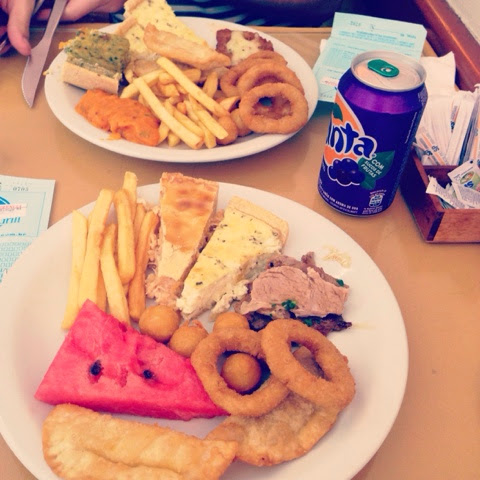
There is a brilliant type of restaurant here called 'A Quilo' which are buffets where you are charged by the weight of food on your plate. The prices and standard of food on offer vary hugely, as you might expect, but we have found some cheaper ones we have been very happy with.

One of these is a place called Express Grill just off of the Copacabana beach which charges R$3.99 per 100g between 11:00 - 12:15 and as a result we've found ourselves in there stocking up on some brunch relatively often.

The food you can expect to see on offer are salads (be careful as these will often be washed with tap water), grilled meats such as chicken & white fish, flavoured & plain rices, mashed potato, chips and boiled veg. Many also have authentic Brazilian fare such as Feijoda (a black bean stew), Bobo de camarao (a shrimp based stew) and Salgado (various types of finger food), plus many more dishes to try! Lots of these restaurants also offer sushi or grilled meat to order (known locally as Churrasco), but these can cost extra so we have avoided them so far. You also have to pay extra for dessert but again these are done on a pay by weight basis and often include cakes, ice creams and gateaux. Another nice touch that we've found at many of the places we've been is that they offer a free Brazilian tea, coffee or hot chocolate at the end of your meal.

Other favourites of ours include Aipo Aipim, Estacao Sabor and Temperarte all of which are located around Copacabana beach.

The important thing to remember here is that this is not gourmet gastronomy and if you're looking to save a few pennies for other things later in your trip you can't be too fussy. With that in mind we've found that paying around £3 -£4 each for our main meal of the day is pretty good going considering the amount we get to put in our bellies for that price. Now you can't really argue with that, can you?

Tips:
All of these places offer a takeaway option for the same price as dining in.
For very hungry customers there will normally be an all you can eat option.
For money savers, some will have certain times to eat that are cheaper.
Avoid extras like cooked to order meats and sushi to keep costs down.
Before going for dessert, be aware most places include fresh fruit as part of the main buffet.